Antipodes of the United States
The map below highlights the area on the opposite side of the world corresponding to the United States:
Activate 3D Map to use this option.
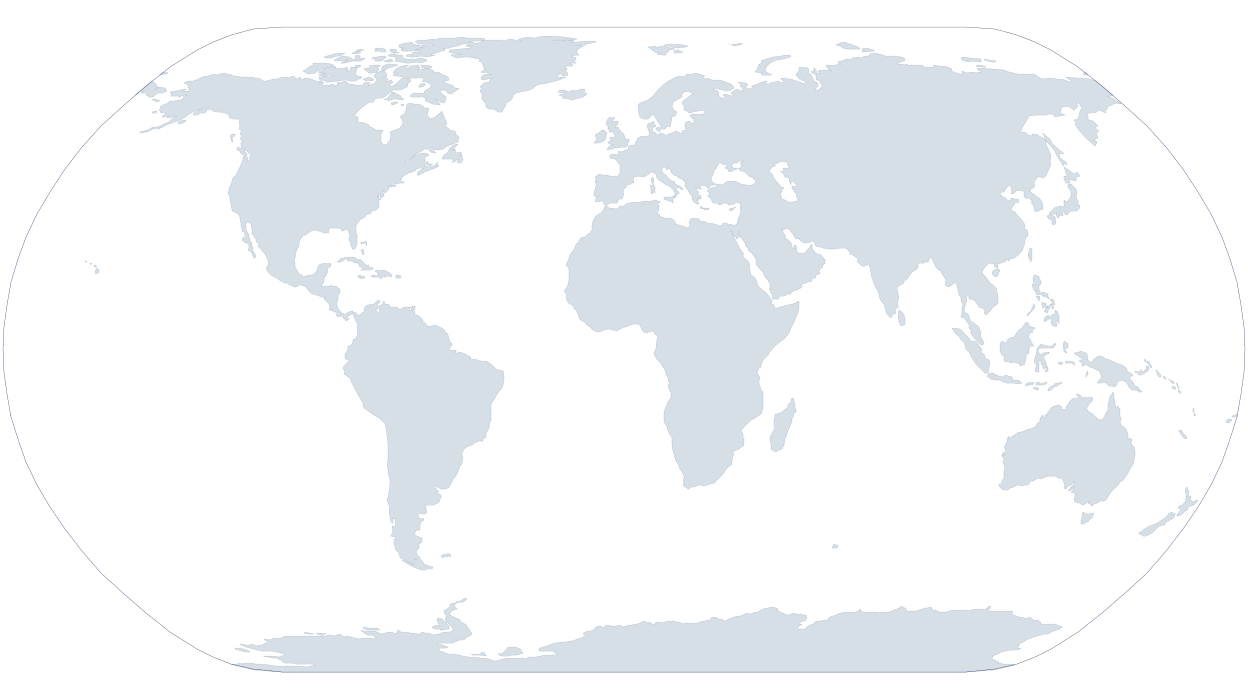
The antipodes of the United States (the points directly opposite on the globe) lie primarily within the southern Indian and Southern Oceans, stretching across the vast open waters between Southern Africa and Australia.
Almost all antipodes of the contiguous U.S. fall in the ocean, except for a few tiny fragments that overlap remote islands. The antipodal region of Alaska skims the edge of the Antarctic coast but remains largely over water. In contrast, Hawaii is a unique case: its entire landmass projects directly onto land in Southern Africa.
- Hawaii's antipode falls within Southern Africa, primarily in Botswana (e.g., Honolulu) with a small portion along the Namibian border (e.g., Kekaha).
- Australia is the nearest landmass for any point opposite the East Coast of the United States.
- West Coast antipodes are located deep in the Indian Ocean; South Africa and Madagascar are the closest countries, though they are over a thousand miles away.
Detailed view
While the map above provides a global view, this detailed map focuses specifically on the antipode of the United States.
Where do the antipodes lie?
The projected area of the United States overlaps the ocean by about 99.5% and land by 0.5%. In terms of area, that is approx. 9,418,756 km² of ocean and 45,472 km² of land. The chart shows the overall split, and the table breaks down the seas and the countries or territories that overlap with the antipodes.
Land and ocean share
| Ocean | 99.5% | 9,418,756 km² |
| Land | 0.5% | 45,472 km² |
Projected area breakdown
| Indian Ocean | 86.0% | 8,143,350 km² |
| Southern Ocean | 12.7% | 1,198,976 km² |
| South Atlantic Ocean | 0.5% | 44,402 km² |
| Other ocean (unidentified) | 0.3% | 32,027 km² |
| Antarctica | 0.3% | 27,792 km² |
| Botswana | 0.2% | 16,228 km² |
| French Southern Territories | <0.1% | 836 km² |
| Namibia | <0.1% | 615 km² |
Antipodes of cities in the United States
View the exact antipodal points of the most populated cities in the United States. For other cities, please use the antipode finder.
View the antipodes of:
- New York City, New York
- Los Angeles, California
- Chicago, Illinois
- Houston, Texas
- Phoenix, Arizona
- Philadelphia, Pennsylvania
- San Antonio, Texas
- San Diego, California
- Brooklyn, New York
- Dallas, Texas
- Queens, New York
- Jacksonville, Florida
- Fort Worth, Texas
- San Francisco, California
- Manhattan, New York
- The Bronx, New York
- San Jose, California
- Austin, Texas
- Miami, Florida
- Columbus, Ohio
- Charlotte, North Carolina
- Indianapolis, Indiana
- Seattle, Washington
- Denver, Colorado
- Washington, District of Columbia
- Nashville, Tennessee
- Oklahoma City, Oklahoma
- El Paso, Texas
- Boston, Massachusetts
- Portland, Oregon
- Detroit, Michigan
- Las Vegas, Nevada
- New South Memphis, Tennessee
- Memphis, Tennessee
- Louisville, Kentucky
- Baltimore, Maryland
- South Boston, Massachusetts
- Albuquerque, New Mexico
- Milwaukee, Wisconsin
- Tucson, Arizona
- Fresno, California
- Sacramento, California
- Atlanta, Georgia
- Omaha, Nebraska
- Raleigh, North Carolina
- Kansas City, Missouri
- Mesa, Arizona
- Colorado Springs, Colorado
- Oakland, California
- Tampa, Florida
- Tulsa, Oklahoma
- Minneapolis, Minnesota
- Wichita, Kansas
- Arlington, Texas
- Bakersfield, California
- Cleveland, Ohio
- New Orleans, Louisiana
- Aurora, Colorado
- Honolulu, Hawaii
- Anaheim, California
- Orlando, Florida
- Lexington, Kentucky
- Riverside, California
- Corpus Christi, Texas
- Lexington-Fayette, Kentucky
- Cincinnati, Ohio
- Santa Ana, California
- Stockton, California
- Pittsburgh, Pennsylvania
- Saint Paul, Minnesota
- Lincoln, Nebraska
- Anchorage, Alaska
- Henderson, Nevada
- Greensboro, North Carolina
- Plano, Texas
- Newark, New Jersey
- Madison, Wisconsin
- St. Louis, Missouri
- Chula Vista, California
- Toledo, Ohio
- Jersey City, New Jersey
- Reno, Nevada
- Chandler, Arizona
- Fort Wayne, Indiana
- Buffalo, New York
- Durham, North Carolina
- Irvine, California
- Laredo, Texas
- Lubbock, Texas
- Winston-Salem, North Carolina
- Glendale, Arizona
- Long Beach, California
- Hialeah, Florida
- Garland, Texas
- Scottsdale, Arizona
- Irving, Texas