Population of Algeria
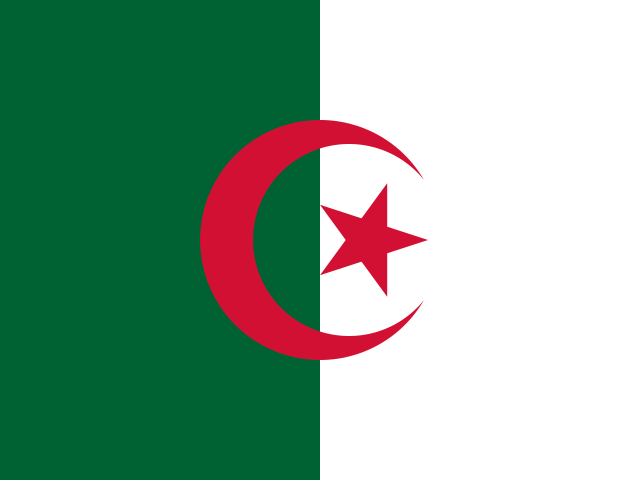
As of August 2026, the population of Algeria is 48.1 million. The number of inhabitants has increased by 578 thousand in the last year, representing a growth of 1.25%. The median age of the population has increased in recent years, rising from 26.8 years in 2016 to 28.8 years in 2026. Currently, life expectancy at birth is 76.9 years and population density is 20.2 inhabitants per square kilometer.
Loading…
Couldn’t load. Please try again.
No results
You can compare up to 5 countries. Remove one to add another.
Population Growth
The population growth rate of Algeria peaked in 1975, reaching around 4.58% annually, but has since declined to approximately 1.2% in 2026. The annual increase in the number of people has also decreased from a peak of around 842.96 thousand in 2016 to nearly 578.46 thousand in 2026.
Loading…
Couldn’t load. Please try again.
No results
You can compare up to 5 countries. Remove one to add another.
Life Expectancy
In Algeria, life expectancy at birth has been increasing, with the indicator rising from 73.1 years in 2006 to 76.9 years in 2026, representing an increase of almost 4 years over the past 2 decades.
Loading…
Couldn’t load. Please try again.
No results
You can compare up to 5 countries. Remove one to add another.
Most populous cities in Algeria
Algeria has several cities considered medium-sized by their number of inhabitants, but there are also some large ones. The most populous city is Algiers, con una diferencia significativa sobre las demás, alcanzando approximately 2.4 million inhabitants. It is followed by Oran with 803.3 thousand and Constantine with 448 thousand.
These are the 20 most populous cities in Algeria:
| # | City | Population |
|---|---|---|
| 1 | Algiers | 2,364,230 |
| 2 | Oran | 803,329 |
| 3 | Constantine | 448,028 |
| 4 | Annaba | 342,703 |
| 5 | Blida | 331,779 |
| 6 | Batna | 289,504 |
| 7 | Bab Ezzouar, Algiers | 275,630 |
| 8 | Djelfa | 265,833 |
| 9 | Sétif | 252,127 |
| 10 | Sidi Bel Abbes | 210,146 |
| # | City | Population |
|---|---|---|
| 11 | Biskra | 204,661 |
| 12 | Tébessa | 194,461 |
| 13 | El Oued | 186,525 |
| 14 | Skikda | 182,903 |
| 15 | Tiaret | 178,915 |
| 16 | Chlef | 178,616 |
| 17 | Béjaïa | 176,139 |
| 18 | Tlemcen | 173,531 |
| 19 | Ouargla | 169,928 |
| 20 | Béchar | 165,241 |